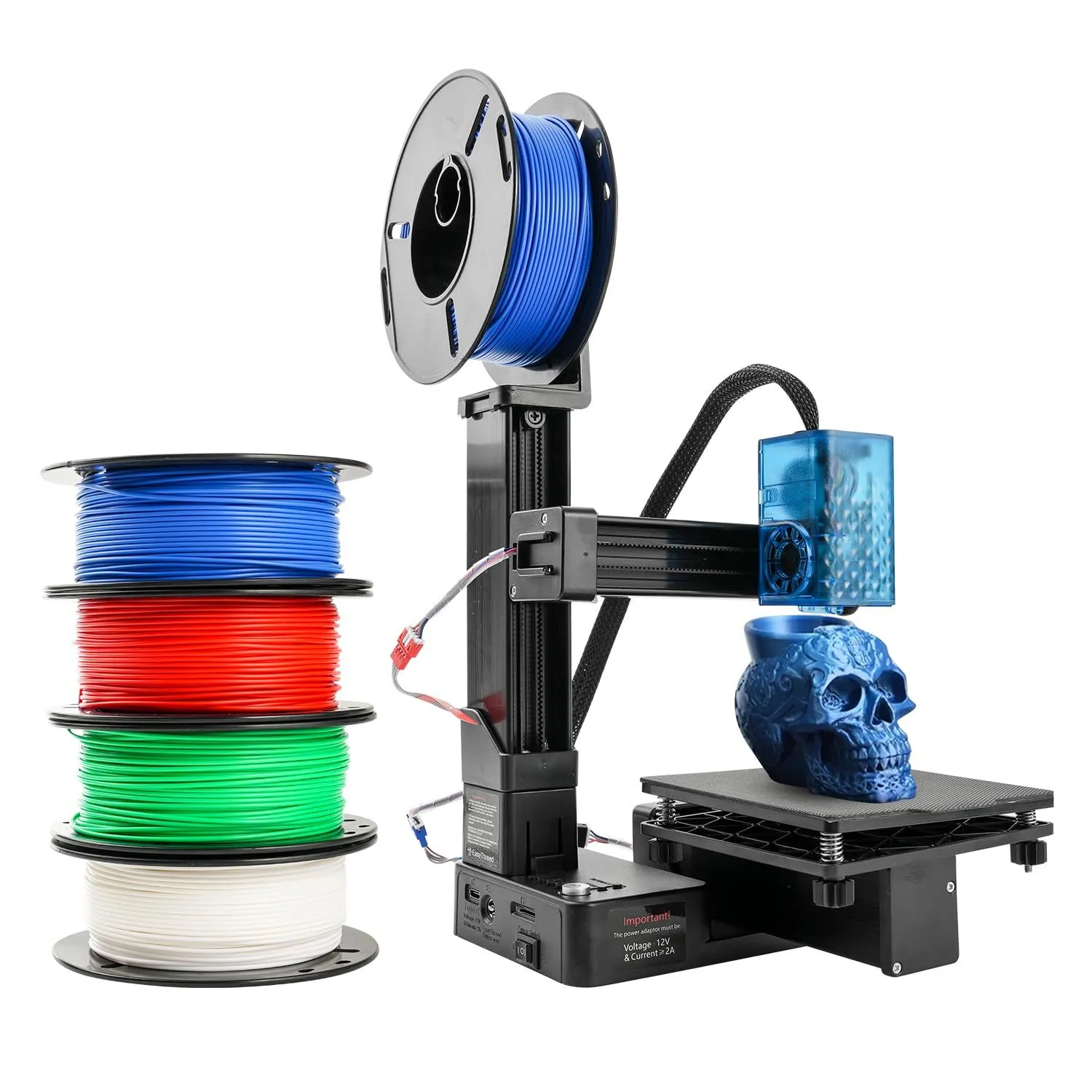
The kiMing Mini 3D Printer for Beginners with 4 PLA Filaments offers an accessible entry point for hobbyists and students looking to explore the world of additive manufacturing. This portable FDM machine features a compact build volume of 100x100x100mm, making it an ideal choice for small desks or classroom environments where space is at a premium. Designed with a focus on user-friendliness, the unit arrives mostly assembled to ensure a seamless setup process that avoids the frustration often associated with complex DIY kits. With its 0.4mm nozzle and support for standard 1.75mm filament, users can achieve consistent detail on a variety of small-scale projects and creative prototypes.
Consistency and convenience are central to the kiMing Mini 3D Printer for Beginners with 4 PLA Filaments experience. The inclusion of a TF card reader allows for offline printing, meaning you do not need to keep a computer tethered to the device throughout the entire duration of a print job. The machine is engineered to handle PLA material effectively, providing a stable thermal environment for the filament to extrude smoothly. Because the printer is lightweight and features a minimalist frame, it can be easily transported between locations, allowing for a mobile maker station that fits the needs of an active, creative lifestyle without sacrificing the core functionality required for successful 3D prints.
Value is further enhanced by the comprehensive starter package which includes the kiMing Mini 3D Printer for Beginners with 4 PLA Filaments along with four distinct colors of material to get you started immediately. Having multiple colors on hand right out of the box encourages experimentation and allows beginners to see the immediate impact of different aesthetics on their 3D models. The straightforward interface and reliable extrusion system minimize the learning curve, empowering new users to focus on design and innovation rather than technical troubleshooting. Whether you are printing custom toys, household gadgets, or educational models, this mini printer provides a dependable and engaging introduction to the capabilities of modern FDM technology.
FEATURES:
– Four colors PLA filament included
– Portable FDM DIY machine
– TF card reader included
– Easy setup process
– Standard 0.4mm nozzle
– Uses 1.75mm filament
The kiMing Mini 3D Printer for Beginners with 4 PLA Filaments is a compact and user-friendly machine designed to introduce newcomers to the world of additive manufacturing. Featuring a modest build volume of 100x100x100mm, this portable FDM device fits easily on a desk or shelf, making it an excellent choice for home or classroom environments. The inclusion of a 0.4mm nozzle and compatibility with standard 1.75mm filament ensures that users can achieve consistent detail on their smaller projects while learning the fundamental mechanics of 3D printing technology.
– Includes 4 colors of PLA filament
– Portable and lightweight design
– Easy setup process
– Comes with TF card reader
– Ideal for beginners
– Standard 0.4mm nozzle size
– Uses common 1.75mm filament
– Compact 100x100x100mm print size
– Small print volume of 100mm cubed
– Limited to basic FDM technology
– Manual DIY assembly required
– Small 0.4mm nozzle restricts detail
– No built-in wireless connectivity
– Tiny build plate limits projects
The Mini 3D Printer is a beginner-friendly and portable FDM machine that offers an easy setup and includes a TF card reader along with four colors of PLA filament to get users started immediately. While its lightweight design and use of standard 1.75mm filament make it an accessible entry point for hobbyists, it is held back by a very small 100mm cubed print volume and a tiny build plate that significantly limits the size of projects. Additionally, users must navigate a manual DIY assembly process and cope with a lack of built-in wireless connectivity, meaning that while it is a convenient and compact tool, its utility is restricted to basic, small-scale prints. Read more…
A Digital Artist Working with 3D Printing Technology
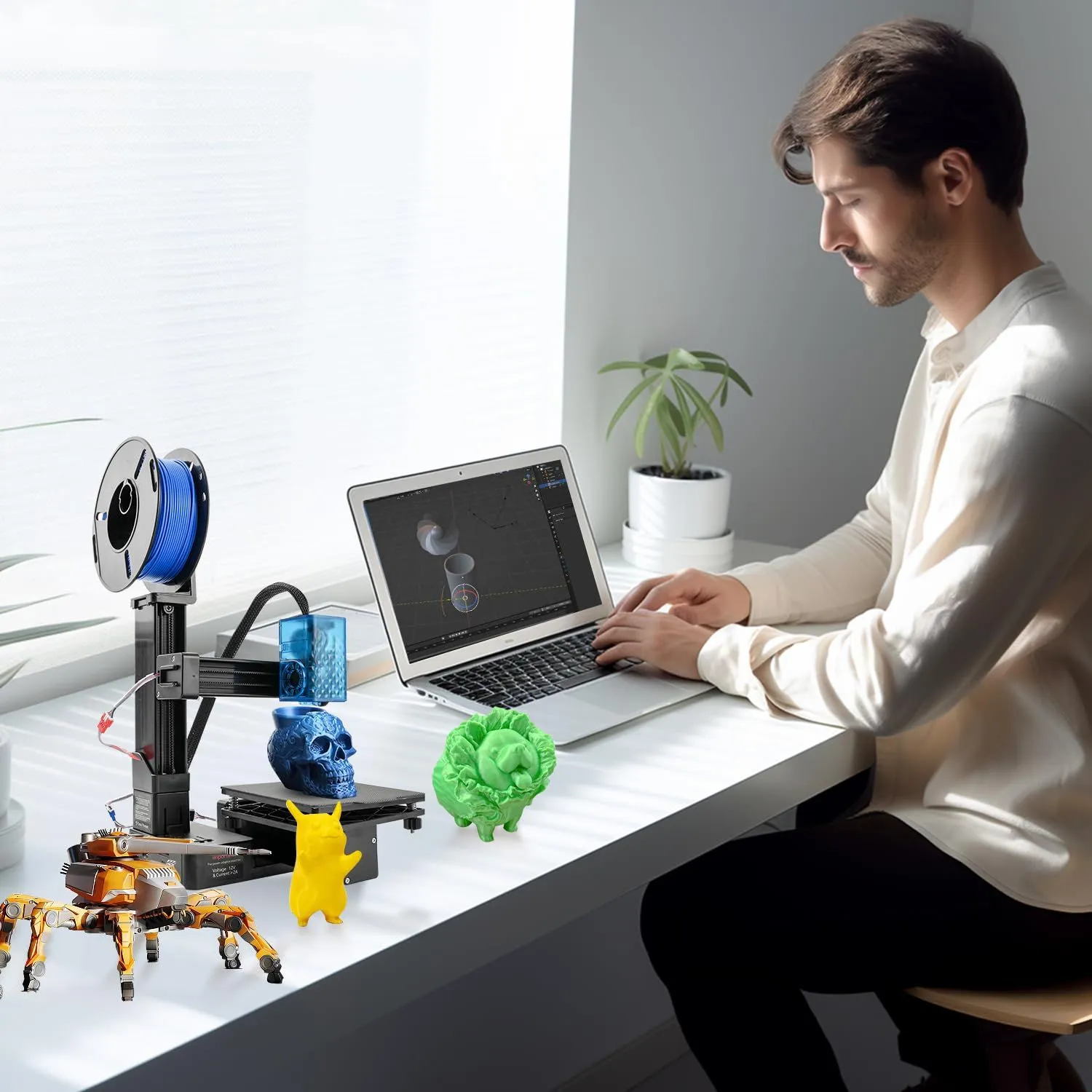
A young man with dark hair and a beard sits at a long white desk in a bright, minimalist room, focused on his silver laptop which displays a 3D modeling interface. To his left, a compact black 3D printer is in the middle of a build, topped with a spool of vibrant blue filament. Scattered across the desk are several completed 3D-printed models that showcase a variety of colors and intricate designs: a detailed blue skull resting on the printer bed, a bright yellow cartoon figurine, a textured green sheep-like creature, and a complex orange and black robotic quadruped. The scene is bathed in soft, natural light coming from a large window behind the desk, highlighting the clean aesthetic of the workspace which is further accented by a small potted plant in the background. The composition captures a seamless blend of digital creativity and physical manufacturing, emphasizing a modern maker’s environment.
3D Printer Assembly Sequence Diagram
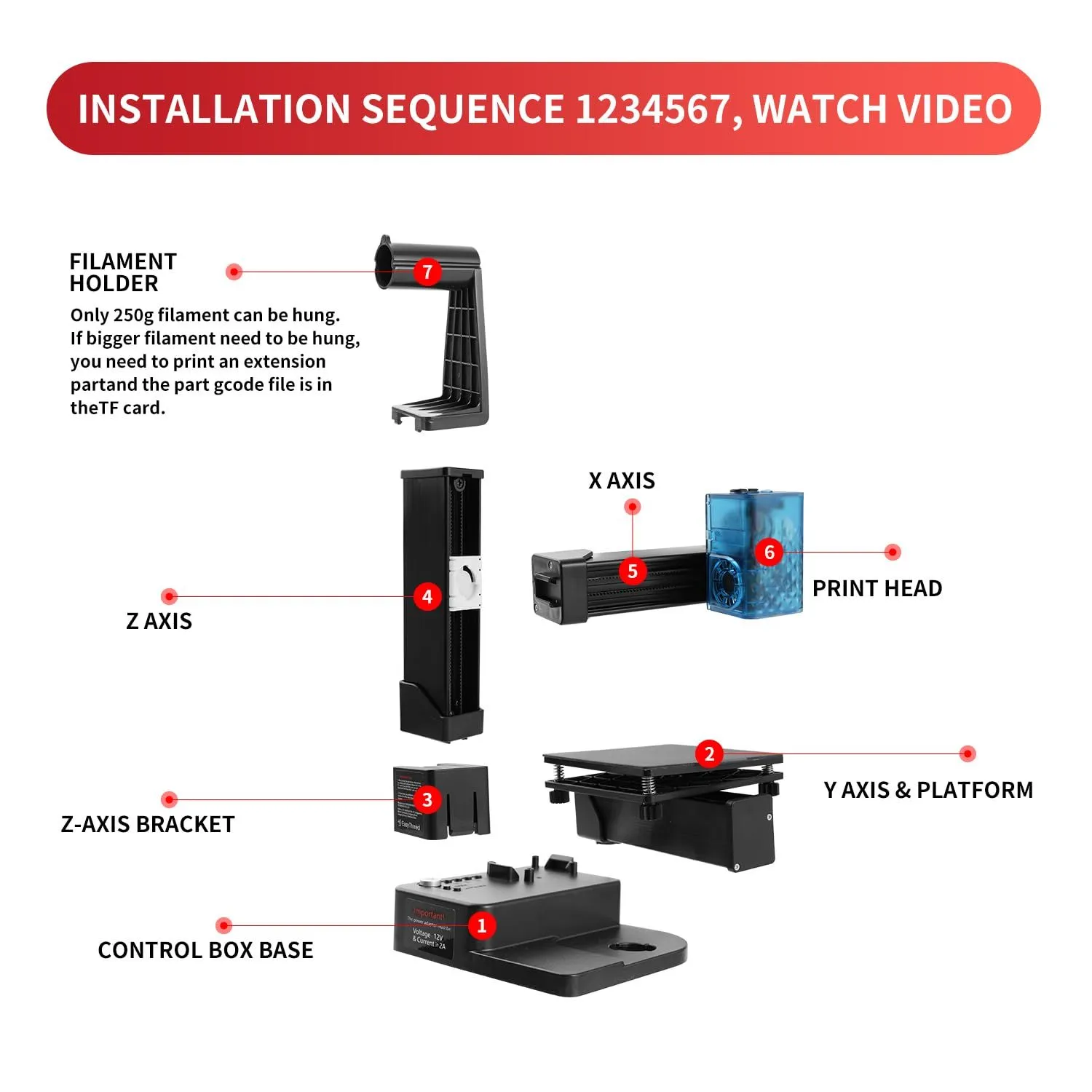
This instructional image provides a visual guide for the seven-step assembly sequence of a compact 3D printer. Set against a clean white background, the various components of the printer are shown in an exploded view, each labeled with a red circular badge containing a white number from 1 to 7. The process begins at the bottom with the Control Box Base (1), followed by the Y Axis & Platform (2). The vertical assembly includes the Z-Axis Bracket (3) and the Z Axis pillar (4). The horizontal components consist of the X Axis arm (5) and the blue translucent Print Head (6). Finally, the Filament Holder (7) is shown at the top, accompanied by a note stating it is designed for 250g spools unless an extension is printed using a file located on the included TF card. A prominent red banner at the top reinforces the installation order with the text ‘INSTALLATION SEQUENCE 1234567, WATCH VIDEO’.
Product Advantages of a Compact Laser Engraver
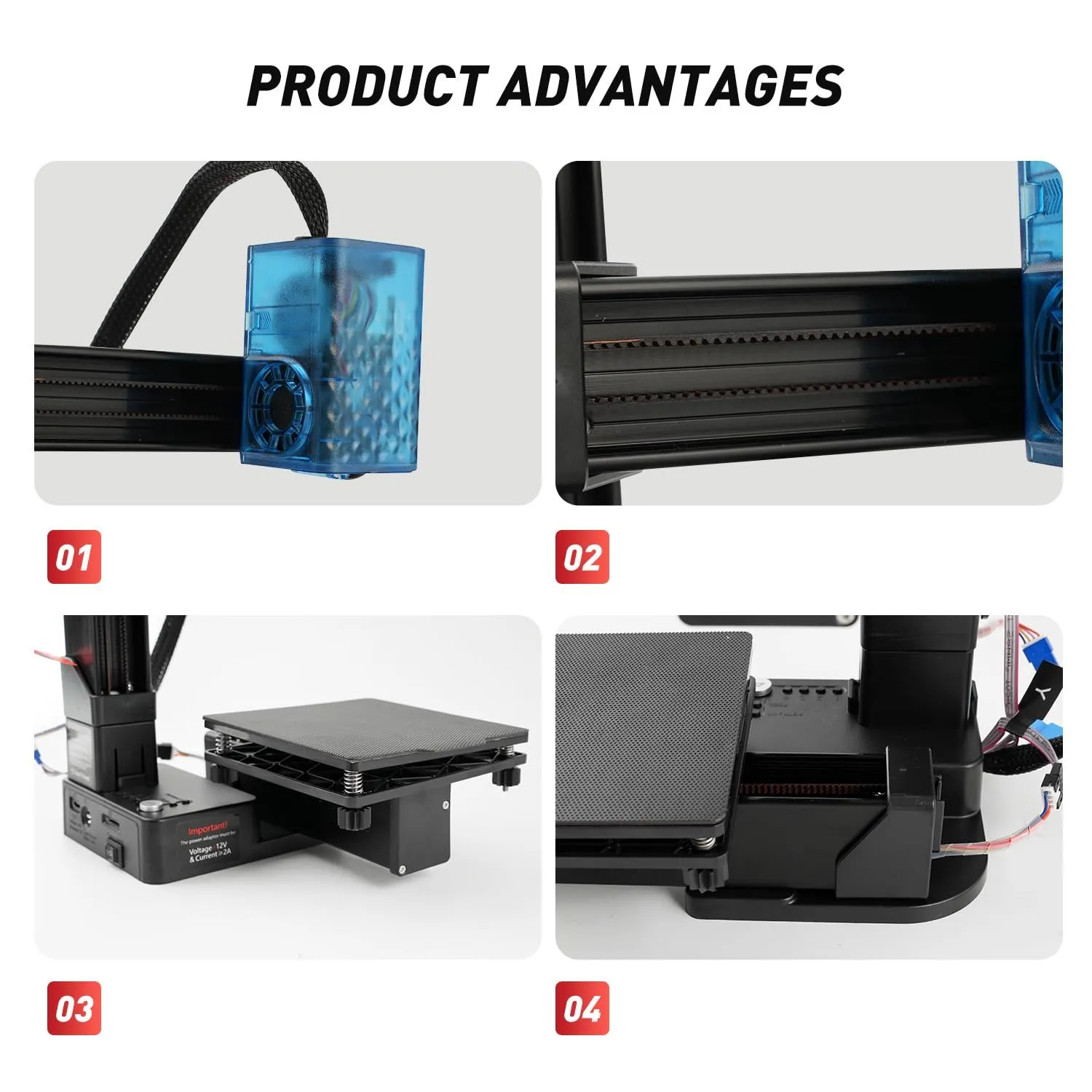
The image is a promotional graphic titled PRODUCT ADVANTAGES featuring four numbered close-up panels of a black and blue desktop laser engraving machine. Panel 01 displays the laser module encased in a translucent blue textured housing with a side-mounted cooling fan, attached to a black gantry with a visible belt drive. Panel 02 provides a macro view of the internal mechanism, highlighting the ribbed rubber timing belt and metal guide rails within the gantry. Panel 03 showcases the machine’s base and engraving platform, revealing a spring-loaded leveling system under the bed and a power input area with a red ‘Important!’ warning label specifying a 12V and 2A power requirement. Panel 04 focuses on the side profile of the base, showing the interaction between the platform and the main chassis, with various colored wires and a black braided cable extending from the rear. The entire composition is set against a clean, white background to emphasize the mechanical details and build quality of the device.
Ultra Silent 3D Printing Promotional Graphic
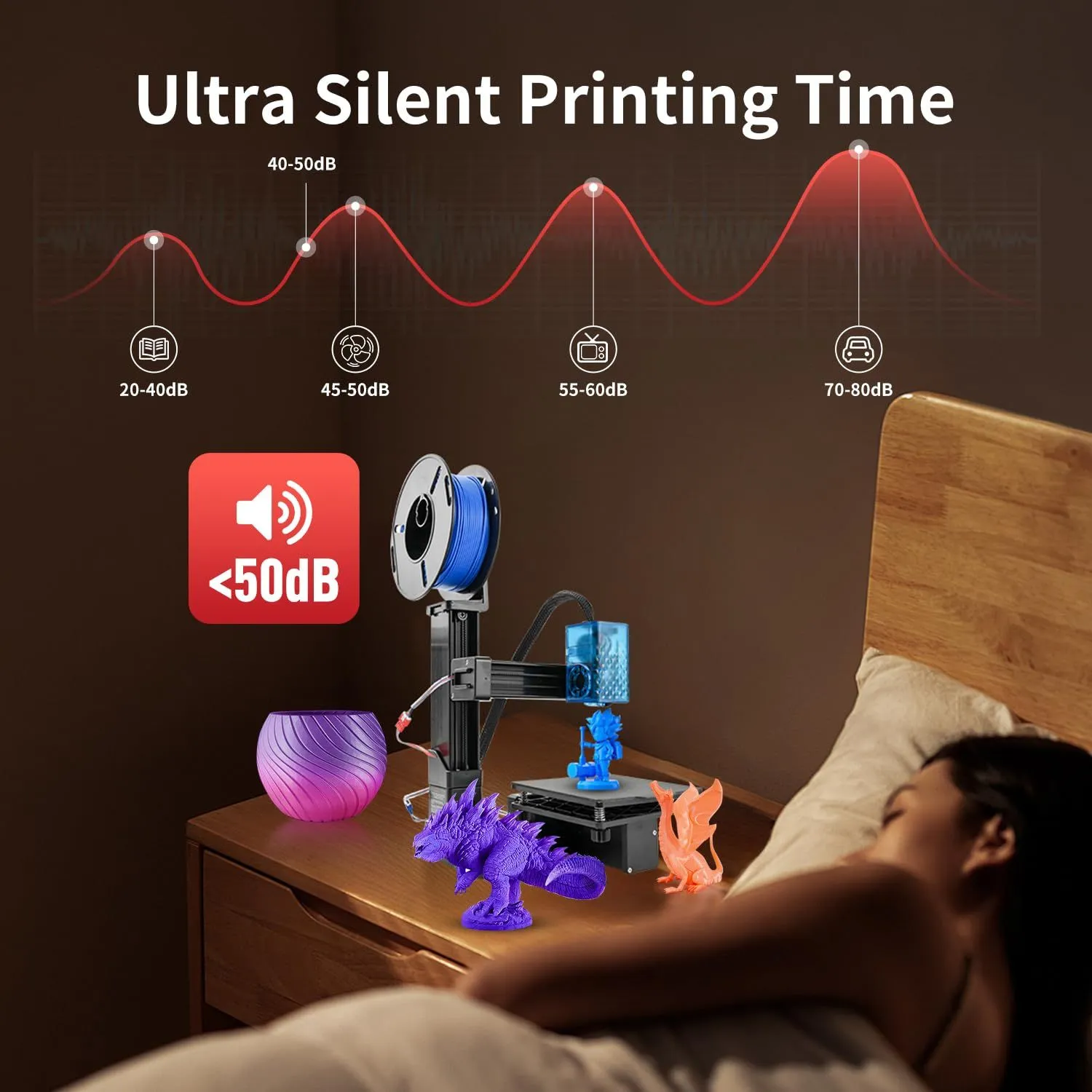
An advertisement for a 3D printer emphasizes its ‘Ultra Silent Printing Time’ by depicting the machine operating quietly on a wooden nightstand next to a sleeping person. The graphic features a prominent red icon stating the noise level is less than 50dB, comparing this to a visual decibel scale that ranges from a library setting (20-40dB) to a car (70-80dB). The printer itself is small and black, currently printing a blue figurine while several other completed models�including a purple monster, a gradient-colored bowl, and an orange dragon�are displayed nearby. A blue filament spool is mounted on the top of the printer’s frame. In the foreground, the side profile of a person is shown resting peacefully on a pillow, suggesting that the printer’s operation is quiet enough not to disturb sleep. The background consists of a dark wall with a red glowing waveform graphic that visually represents the varying sound levels of different environments.
3D Printer Performance and Output Showcase
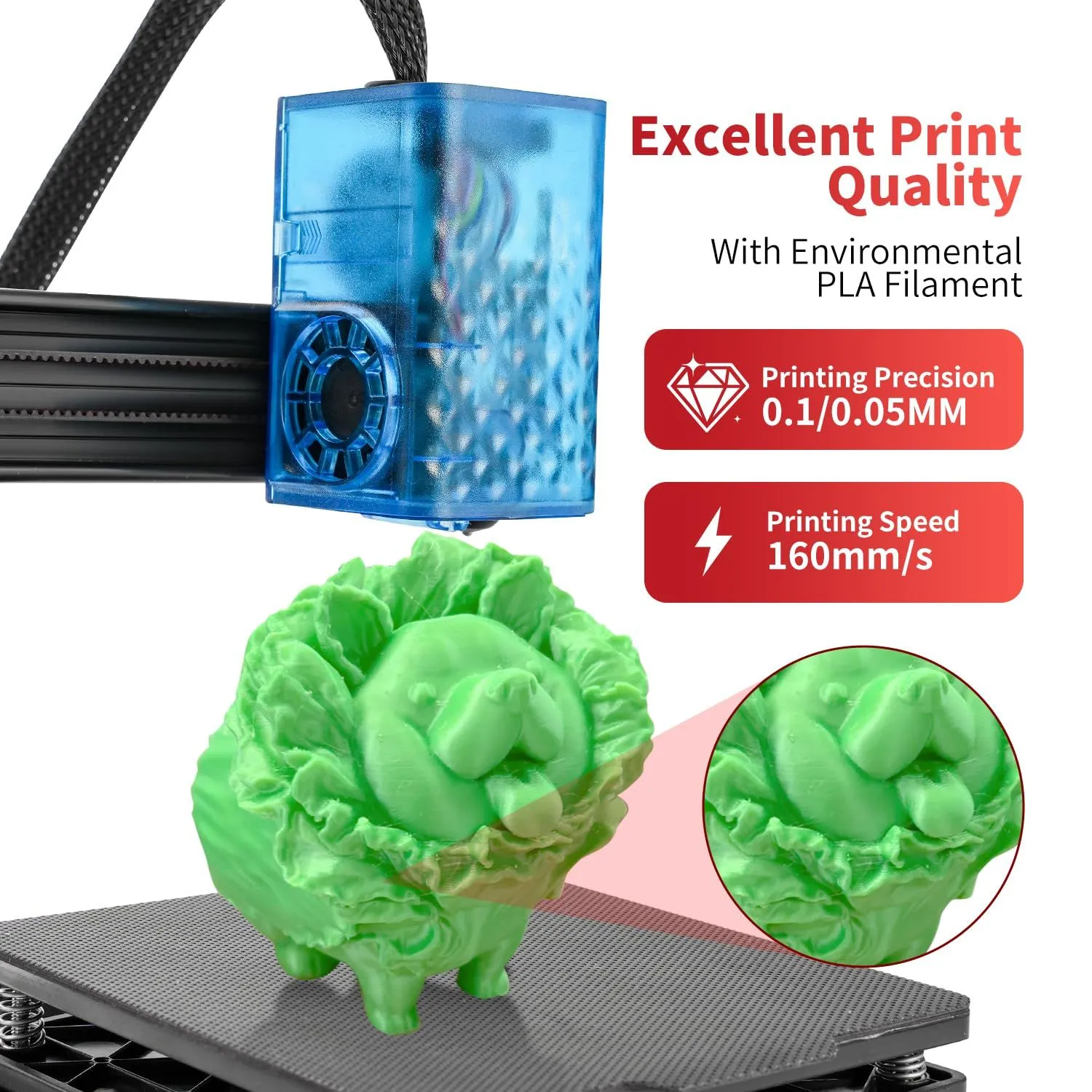
A promotional graphic highlights the capabilities of a 3D printer, featuring a translucent blue extruder head positioned above a textured black print bed. The printer is shown in the process of creating a vibrant green, highly detailed figurine of a dog nestled within a cabbage-like structure. Beside the printer, bold red and white text blocks emphasize ‘Excellent Print Quality’ and specify the use of environmental PLA filament. Two distinctive badges list technical specifications: a diamond icon denotes a ‘Printing Precision’ of 0.1/0.05mm, while a lightning bolt icon indicates a ‘Printing Speed’ of 160mm/s. An inset circular zoom provides a close-up view of the printed dog’s face, illustrating the smooth surface finish and intricate details of the finished model.
A Desktop 3D Printer Showcase of Fantasy Figurines
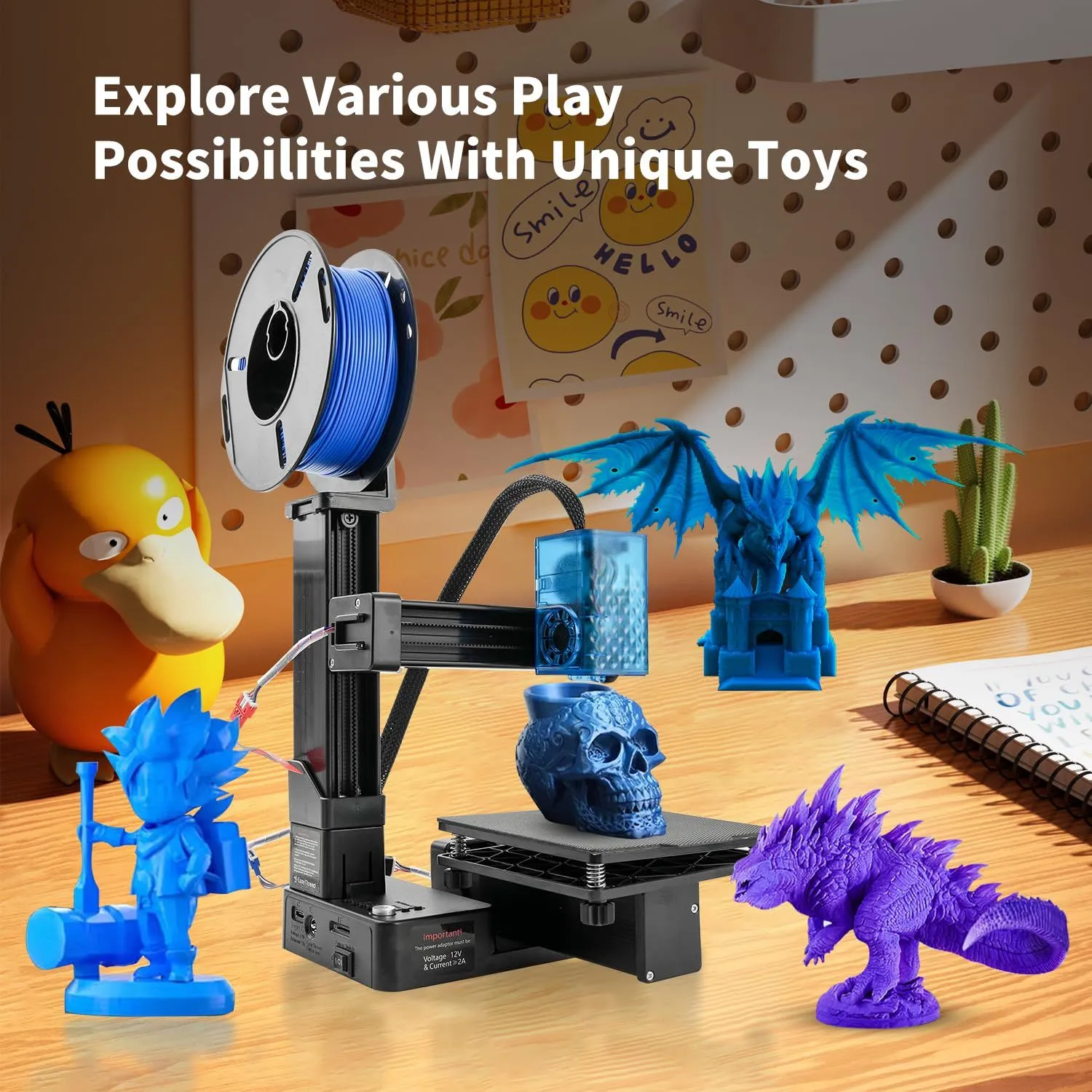
This image displays a compact, cantilever-style 3D printer set up on a wooden desk, surrounded by several finished plastic models. The printer features a black vertical frame with a spool of blue filament mounted at the top, leading into a blue transparent extruder head that is currently positioned over a blue-printed decorative skull. The scene is highly stylized, featuring a bright, warm lighting environment with a pegboard background decorated with ‘Smile’ and ‘Hello’ stickers. To the left of the printer stands a large yellow Psyduck toy and a blue anime-style character figurine holding a staff. To the right, a large blue winged dragon perched on a castle and a purple spiky reptilian monster are displayed. A small cactus in a white pot and a notebook are also visible on the desk, creating a creative and playful atmosphere. Text at the top of the image reads ‘Explore Various Play Possibilities With Unique Toys,’ while a small warning label on the printer’s base specifies the power requirements of 12V and at least 2A.
K10 3D Printer Features and Important Tips Overview
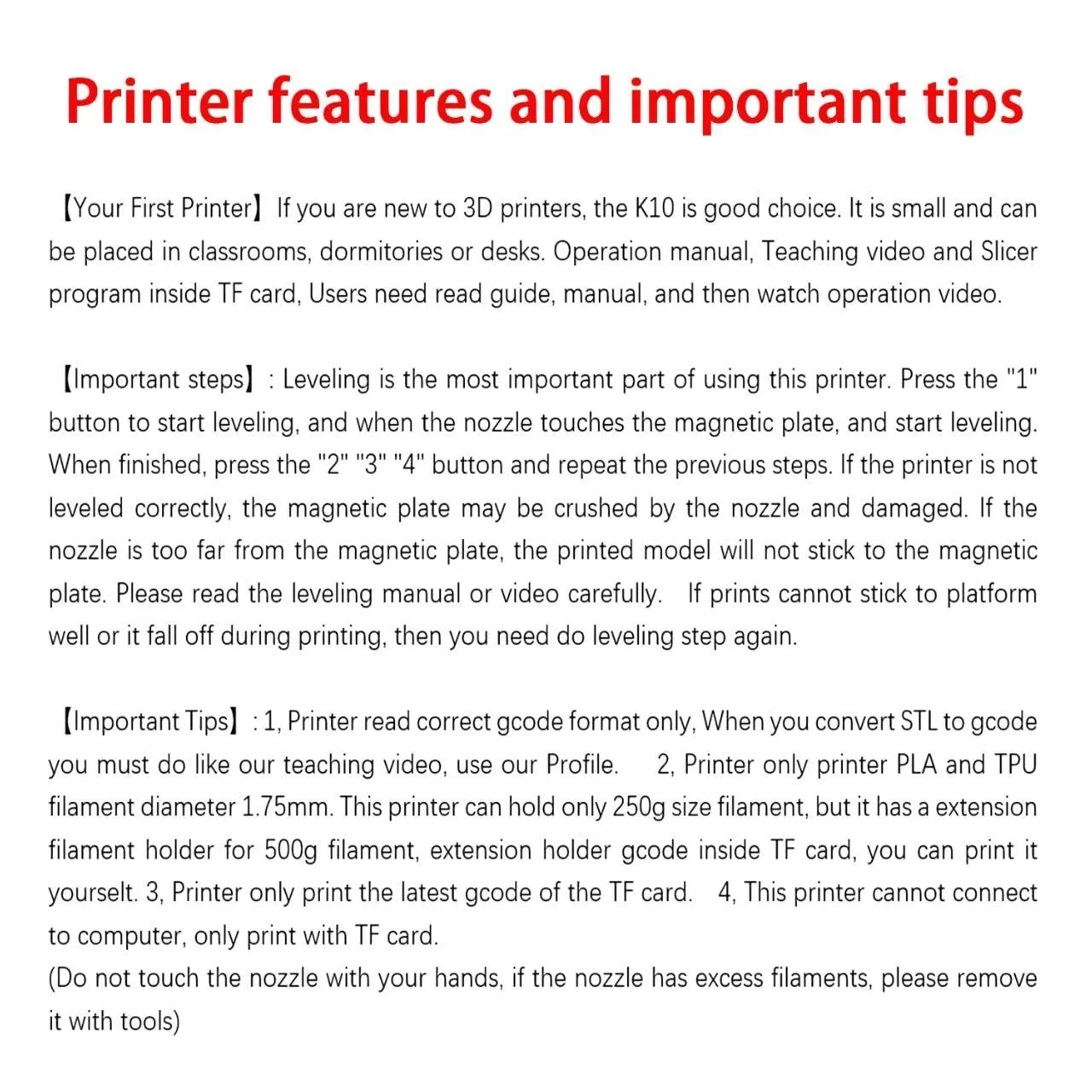
This image is a digital document titled ‘Printer features and important tips’ in large red font, providing essential guidance for users of the K10 3D printer. The text is divided into three main sections: ‘Your First Printer,’ ‘Important steps,’ and ‘Important Tips.’ The first section introduces the K10 as a beginner-friendly, compact device suitable for classrooms or dorms, noting that instructional materials are provided on an included TF card. The ‘Important steps’ section emphasizes that bed leveling is the most critical process, warning that improper leveling can lead to a damaged magnetic plate or failed prints where the model does not adhere. It describes a numbered button sequence for the leveling process. The ‘Important Tips’ section lists technical requirements, specifying that the printer only reads gcode, requires 1.75mm PLA or TPU filament, and primarily supports 250g spools unless an extension holder is printed. It also clarifies that the printer functions exclusively via TF card and cannot connect directly to a computer. A final safety warning at the bottom advises users never to touch the nozzle with their hands and to use tools for removing excess filament.
Google search results for a kiMing mini 3D printer for beginners.
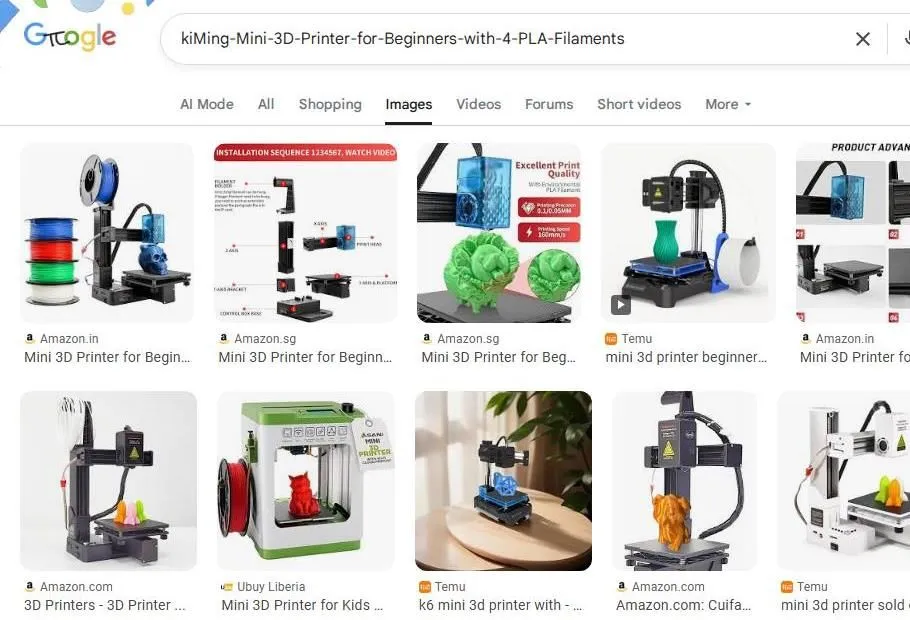
The image displays a Google Images search result page for the query ‘kiMing-Mini-3D-Printer-for-Beginners-with-4-PLA-Filaments.’ The interface shows a grid of product photos from various e-commerce platforms such as Amazon and Temu. Most of the featured printers are compact, entry-level FDM (Fused Deposition Modeling) machines characterized by a cantilever design or a small enclosed frame. These printers are shown alongside colorful spools of PLA filament and small printed models like skulls, frogs, and vases to demonstrate their output. One specific thumbnail includes an ‘installation sequence’ diagram, indicating a semi-assembled kit. The color schemes of the hardware vary from sleek black and blue to white and lime green, emphasizing a user-friendly and approachable aesthetic aimed at children or hobbyist beginners. The search bar at the top remains visible, along with navigation tabs for ‘All,’ ‘Shopping,’ and ‘Videos.’
Google Search Results for Mini 3D Printers for Beginners
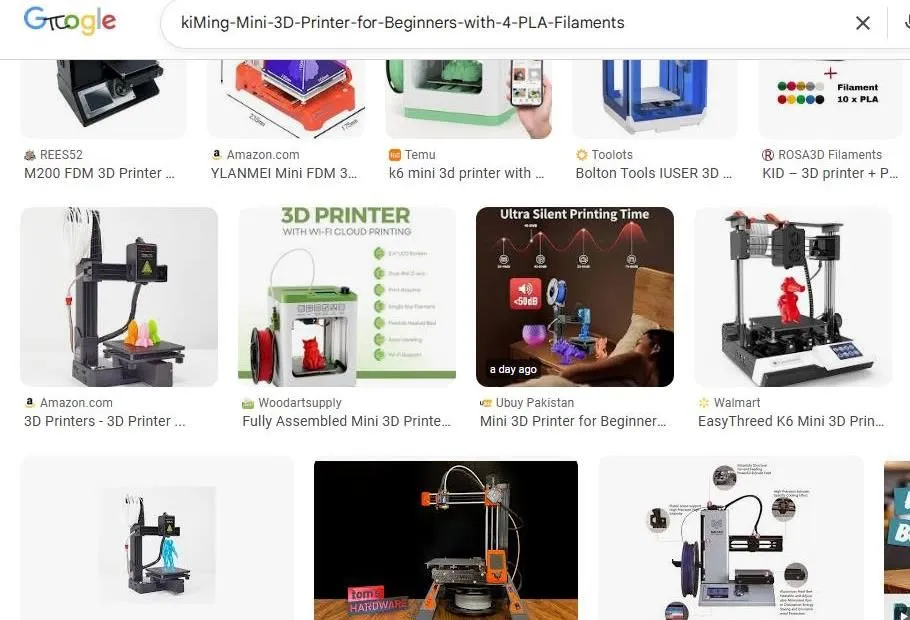
The image displays a grid of Google search results for the query ‘kiMing-Mini-3D-Printer-for-Beginners-with-4-PLA-Filaments,’ showcasing various compact FDM (Fused Deposition Modeling) 3D printers from multiple retailers. The top row features listings from REES52, Amazon, Temu, Toolots, and ROSA3D, showing enclosed and semi-enclosed desktop models alongside filament bundles. The middle row highlights several variations of the EasyThreed K6 and similar mini printers, with one advertisement from Ubuy Pakistan emphasizing ‘Ultra Silent Printing Time’ under 50dB and another from Walmart showing a model with a prominent red printed figure. The bottom row includes a detailed technical breakdown of a printer’s components from Tom’s Hardware and a schematic-style image labeling parts like the high-precision nozzle and heat-dissipating fan. Most of the featured printers are small-form-factor machines designed for hobbyists, featuring simple control interfaces and exposed or partially shielded build plates, primarily aimed at entry-level users interested in PLA printing.
A Google Search result page showing an AI Overview for a mini 3D printer.
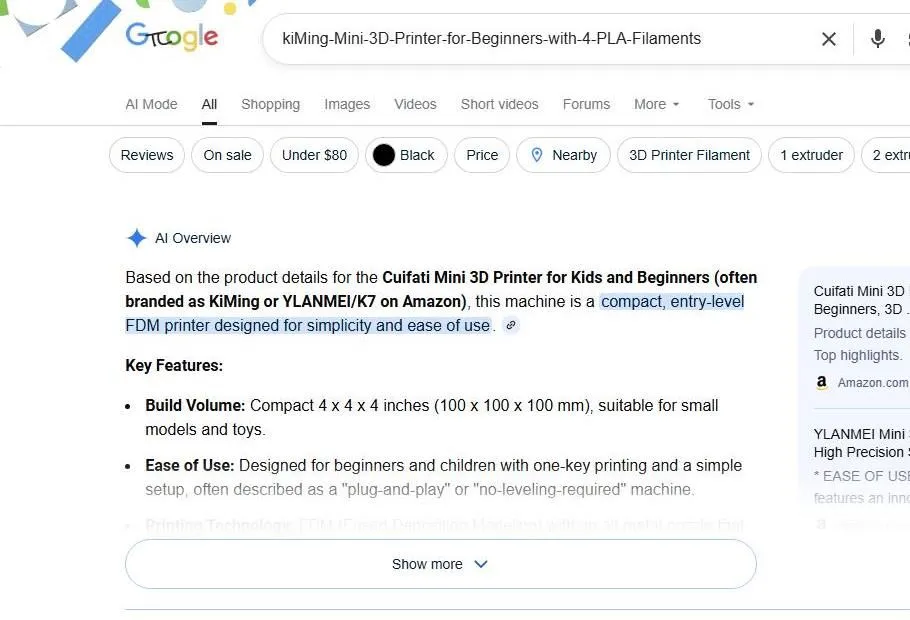
The image displays a Google Search interface featuring an AI Overview for a ‘kiMing-Mini-3D-Printer-for-Beginners-with-4-PLA-Filaments.’ The AI-generated summary identifies the product as the Cuifati Mini 3D Printer, noting it is also branded as KiMing or YLANMEI/K7 on Amazon. Key features highlighted in the summary include a compact build volume of 4 x 4 x 4 inches (100 x 100 x 100 mm) and a user-friendly design described as ‘plug-and-play’ for children and beginners. Above the overview, search filter chips like ‘Under $80,’ ‘Black,’ and ‘Price’ are visible, while a sidebar on the right shows Amazon product listings. The layout is clean and modern, utilizing standard Google branding and typography to organize the product specifications and shopping options.
A digital storefront display of various consumer 3D printers.
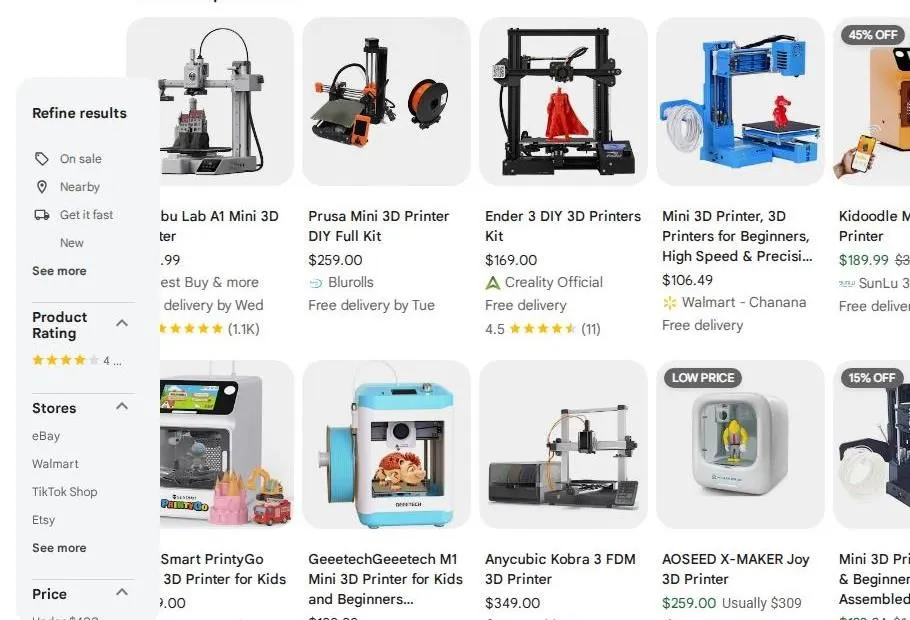
The image shows a grid-style layout of a search results page for 3D printers, featuring a diverse array of models ranging from open-frame DIY kits to enclosed, kid-friendly designs. On the left side, a navigation sidebar offers filtering options such as ‘On sale’, ‘Nearby’, ‘Product Rating’, ‘Stores’ (listing eBay, Walmart, TikTok Shop, and Etsy), and ‘Price’. The product cards display high-resolution images of the printers along with titles, prices, and shipping information. Notable models include the Bambu Lab A1 Mini, Prusa Mini, Ender 3 DIY, and several specialized units for beginners like the Anycubic Kobra 3 and the AOSEED X-MAKER Joy. Prices vary significantly across the listings, with some items featuring promotional tags like ‘LOW PRICE’ or percentage discounts. The overall aesthetic is a clean, modern e-commerce interface with a focus on product variety and accessibility for hobbyists and educators.
Google Shopping results for mini 3D printers
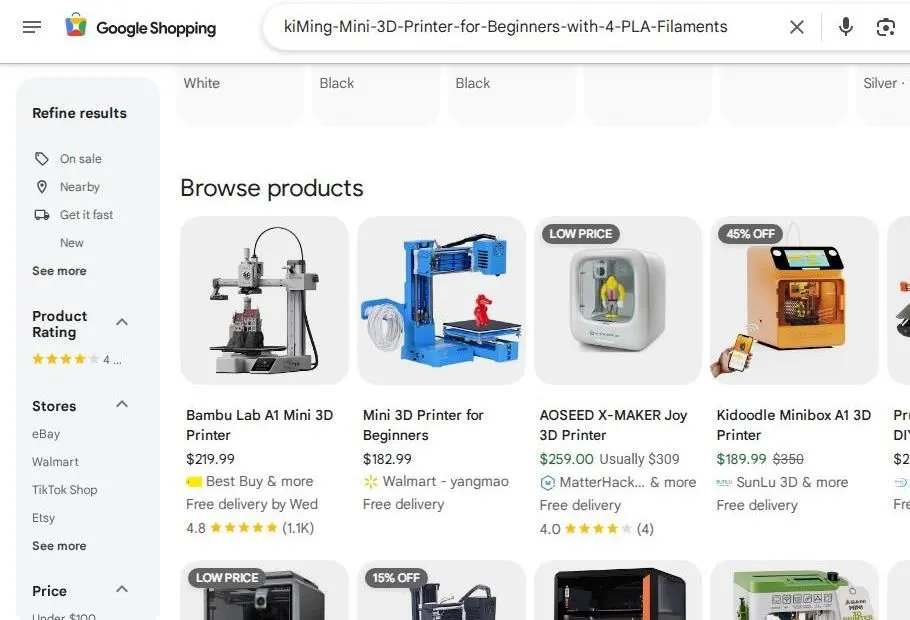
A digital screenshot of a Google Shopping search page displays a variety of mini 3D printers intended for beginners. The search query in the address bar reads ‘kiMing-Mini-3D-Printer-for-Beginners-with-4-PLA-Filaments’. The interface features a sidebar on the left with filtering options such as ‘On sale’, ‘Nearby’, ‘Product Rating’, ‘Stores’, and ‘Price’. The main ‘Browse products’ section showcases four featured items in the top row: a white Bambu Lab A1 Mini priced at $219.99 with a high 4.8-star rating, a blue generic mini 3D printer for $182.99, an enclosed white AOSEED X-MAKER Joy for $259.00 marked as a ‘LOW PRICE’, and an orange Kidoodle Minibox A1 discounted by 45% to $189.99. Each listing includes an image of the device, the price, the seller name�including retailers like Best Buy, Walmart, and MatterHackers�and shipping details such as ‘Free delivery’. The layout is clean and modern, utilizing a white background with light grey accents to organize the product grid.
YouTube Search Results for 3D Printing Beginners
The image displays a desktop web browser view of YouTube search results, specifically focusing on introductory content for 3D printing. At the top of the interface, a search bar contains the query ‘kiMing-Mini-3D-Printer-for-Beginners-with-4-PLA-Filaments’. The left sidebar shows standard navigation options like Home, Shorts, Subscriptions, and History, along with a prompt to sign in. The main content area features several video entries. The most prominent video in the center is titled ‘HOW TO USE A 3D PRINTER FOR COMPLETE BEGINNERS’ from the channel ‘Everything STEM’, showing a modern enclosed 3D printer. Below it, another video titled ‘FILAMENT FOR’ from ‘The Edge of Tech’ shows shelves stocked with various colorful filament spools. To the right of the thumbnails, video metadata including view counts and upload dates are visible, alongside a small ‘Summary’ button powered by AI. The overall layout is clean and typical of the YouTube user interface, emphasizing visual thumbnails to attract new hobbyists to the world of additive manufacturing.